


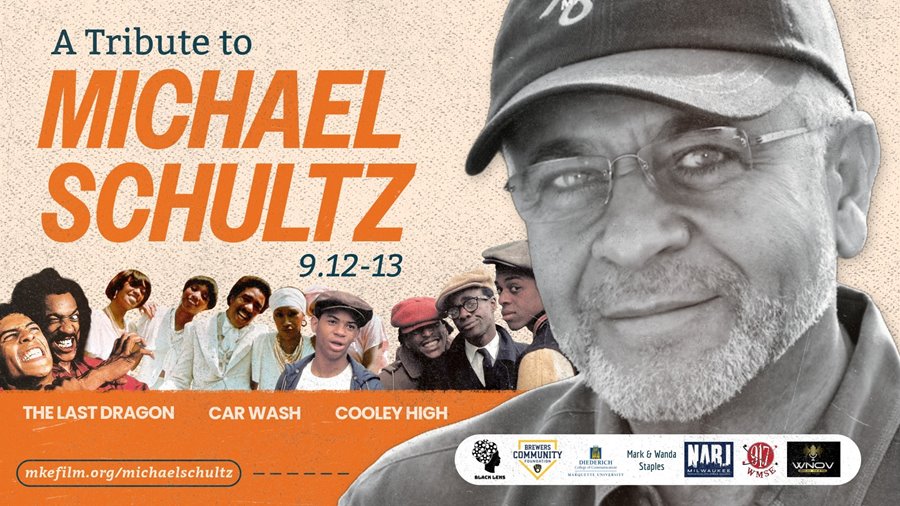
Director Michael Schultz, born and raised in Milwaukee, was recently honored with an award in his name. Spotlighted by Milwaukee Film, several of his films were screened at the local Oriental Theater, including the iconic Cooley High and the comedic Car Wash.

Milwaukee Film presented an inaugural award to its namesake, trailblazing director Michael Shultz, at a tribute event in September 2025.
Shultz is one of the first Black men to consistently direct Hollywood productions, having started working in the cutthroat industry during the 1970s.
The Michael Shultz award, an honor given to luminary Black filmmakers, was sponsored by the Brewers Community Foundation. It was presented to Shultz on September 13 at the Oriental Theatre.
Beyond the accolade, Shultz was gifted a customized Brewers jersey with his name on the back.
In celebrating this special occasion, Milwaukee Film curated three screenings of some of his most influential films from his illustrious and decade-spanning career.
Other sponsors of this event included the Black Lens program, Diederich College of Communication at Marquette University, Mark & Wanda Staples, National Association of Black Journalists of Milwaukee, 91.7 WMSE and WNOV The Voice.
Milwaukee Connection

The director reminisced about his childhood in Milwaukee before there was such a thing as a refrigerator.
“There were ice boxes where the iceman brought cubes of ice, and you put them in a box, and then you put your food in there. And the coal man would come and dump coal into your basement, and you put it in the furnace. So that’s how old I am,” Shultz said.
Shultz was born in Milwaukee and grew up on Vine Street, eventually graduating from Riverside High School.
“Back then, it was fun in a lot of ways. It was strange in a lot of ways because it was very segregated back then,” Shultz said. “There was a street called North Avenue, and on one side of the street were all the black people, and on the other side of the street were all the white people. So, growing up in that environment was a little weird.”
According to the director, much of the city has changed in the last 50 years since he has been here, including the festival venues along the lake.
“That is a huge venue for one festival after another, and it was never there when I grew up,” Shultz said. “I’m renting a car so I can drive around and see what’s really changed.”
For college, Shultz attended Marquette University, pursuing a degree in theater.
After Marquette, the director went to Princeton University, only continuing to chase his passion for storytelling.
Inaugural Michael Shultz Award
The inaugural Michael Shultz Award was given to Shultz by Kwabena Antoine Nixon.
Nixon was asked to do this by Milwaukee Film Executive Director Susan Kerns. Immediately, he was on board.
As a child, Nixon grew up on the West Side of Chicago, which led him to identify with the coming-of-age drama Cooley High, watching the film on television with his family.
The movie was an important catalyst for him to follow his enthusiasm for poetry and tell his own personal story.
Nixon is just one of the many who are frequently inspired by Shultz and his groundbreaking films.
Milwaukee Film Black Lens Program

Ty Williams is the program director of Black Lens at Milwaukee Film.
According to Williams, Milwaukee Film hopes to continue this award moving forward to honor luminary black directors.
Part of his position involves sifting through and finding different films that relate to the African American experience.
In this research, he watched Shultz’s films and realized the director’s Milwaukee origins, which made him the perfect person to name this accolade after.
“I want to do a lot more different events and screenings that highlight the creatives that live here and make really great art while striving to become great directors,” Williams said when talking about future Black Lens programming.
Cooley High (1975)

Cooley High screened right after the presentation of the award. This showing was followed by an extended Q&A with the director.
The independent film is a comedy and a coming-of-age drama. Taking place in Chicago, the plot follows two best friends about to graduate high school, navigating the boisterous city and becoming involved in complicated romantic relationships throughout.
Being shot on location, the overall narrative covers these last couple of weeks spent together, the close-knit pair sneaking out and attending sensational parties as they figure out what exactly to do in their fast-approaching adulthood.
Running into several mistakes in the experimental process, such as having stressful encounters with law enforcement and making a massive mess of their personal lives, the two go through several relatable experiences that ring true even now in the present day.
Countless people in the audience were already familiar with the film. Many remembered growing up and watching the movie as a big part of their childhood, while reminiscing about its emotional moments and how they knew people similar to these vibrant characters.
Cooley High is a culturally significant piece of Black cinema that broke a lot of ground at the time of its release. Heavily including Motown artists in its signature soundtrack and displaying the inner-city in a multi-dimensional way, Shultz made a highly referential picture that has stood the test of time and is incredibly influential to famous directors who followed, like Spike Lee and John Singleton.
Car Wash (1976)

Car Wash screened earlier in the afternoon, before Cooley High and the awards ceremony, but was followed by another Q&A session with the director.
This slice-of-life film was incredibly progressive for the 70s with an inclusive and nicely represented cast, featuring countless people of color and dynamic women as well. Besides its racially diverse crew, Car Wash features a trans-presenting character who, instead of being on the receiving end of jokes, gets to be the one to poke fun.
Audience members follow a group of rambunctious coworkers through a single day of working at a car wash in the L.A. area, fighting off constant boredom and encountering several unusual individuals. Several hijinks ensue, such as a serial bomber currently making headlines in the news visiting the spot and a famous evangelist making a short stop alongside his singing escorts, played by Richard Pryor.
All the while, parallel to these hilarious situations are real-life issues that the animated cast go through, such as becoming involved in revolutionary activities and having to support oneself through sex work, in addition to queer identities and life as an ex-convict.
Shultz wanted to make Car War an exuberant comedy with underlying drama and important social commentary, purposefully incorporating several serious storylines.
After the screening, Shultz discussed a separate cut of the film where the trans character was mostly cut and replaced to be allowed on television, showcasing evident censorship at the time.
The Last Dragon (1985)
The Last Dragon screened, without Q&A, the night before the award ceremony as a prologue to the presentation happening the next day.
This film stands apart from the other two because its overarching narrative tackles much less serious topics and is much more slapstick in nature, being a martial arts action flick.
A constant similarity to the aforementioned movies is the electric Motown soundtrack. Shultz mixes energetic scenes with cheesy moments, all scored to the sounds of iconic artists like Stevie Wonder and Smokey Robinson.
The Last Dragon harkens back to classic Bruce Lee romps, being a fun and campy piece with a straightforward plot.
Future Projects

The iconic director is 86, but he is not interested in stopping, with plans for more creative concepts brought to life coming soon.
Shultz continues his prolific career directing television, but he is not afraid to do something new.
The director is also developing an animated project, which he has had his hands on for decades now and has stuck with this entire time.
However, 20 years ago, the studio did not understand his vision of what he calls “graffiti anime” and refused to pursue.
“It’s really taking the energy of black music and the good hip-hop within an anime style,” Shultz said.
According to the director, AI will be used to make the colorful picture without overspending and costing $100 million.
“There are some good aspects of that technology, and there are some bad aspects. It depends on how it’s going to be used. So, we are tiptoeing into that,” Shultz said.
Audio Interview
Listen below if you would like to hear the UWM Post’s full exclusive interview with Shultz at the Oriental Theatre before he received his award.